Dear Lawn or Landscape Business Owner:
There are a thousand ways to waste money in a lawn and landscape company.
But one of the dumbest might be paying a good employee to hunt for a tool.
Think about pruning.
A pair of Felco #2 hand pruners is perfect for removing little suckers from the trunk of a tree. But put a 2-inch limb in front of you and you better have a good pair of lopping shears.
Need to tighten up a boxwood hedge? Now you might need scissor shears, power shears or an extended-boom power shear.
Different job. Different tool.
Professional landscape companies make difficult work look easy because their people have the right tool, the right training and a system for getting the job done efficiently, safely and correctly the first time.
And that’s where our story about Larry the Landscaper and Johnny the new guy begins.
Larry Didn’t Just Hire Johnny
Larry hired Johnny on Monday morning.
Now Larry could have done what thousands of contractors do every Monday:
“There’s the truck. There’s the crew. Get after it, Johnny.”
Instead, Larry spent a few minutes teaching Johnny the system.
He showed Johnny where the hand pruners went.
He showed him where the lopping shears went.
He showed him where the hedge shears, rakes, shovels and other tools were stored.
Better yet, every storage location was clearly identified with the name of the tool in English and Spanish PLUS a picture of the tool.
Johnny didn’t have to know what a lopping shear was on Monday morning.
He could see the picture.
When Johnny finished pruning that oak tree, Larry taught him one simple rule:
Put the lopping shears back where they belong. Every time.
Sounds ridiculously simple, doesn’t it?
But simple systems build great businesses.
The lopping shears aren’t bouncing around in the truck getting bent or broken.
Nobody leaves them laying in the grass because the crew can easily see an empty tool storage rack.
And tomorrow morning another employee doesn’t spend 10 minutes saying:
“Hey, where are the loppers?”
Here's the financial facts about wasting time looking for tools. And whether we're talking about the Felco #2 hand pruner, a lopping sheer, a half inch wrench, or a tool to change the blade on your edger… tool organization matters!
If your 3-man crew wastes 20 minutes per day and works 200 days per year, your team was unproductive for 12,000 minutes.
Here's the math:
3 men x 20 minutes/day x 200 days = 12,000 minutes/ 60 minutes/hour = 200 man hours
If you consider the cost of labor with labor, burden and benefits at $30 per hour, then you can see that the lack of organization cost $6,000.00 (ouch)!
But if you consider your lost opportunity to bill out an additional 200 man hours of work at a sales price of $70 per man hour you missed out on $14,000 in revenue.
Here's the math:
200 man hours x $70/hour = $14,000 in billed work
Larry is a very smart landscaper to spend all the time necessary to train Johnny how to use his tool storage system. The productivity boost makes a massive impact on the bottom line.
There’s an old saying:
A place for everything and everything in its place.
I’d add one more thing :
By removing a $6,000 expense and replacing it with a $14,000 income, you just made a $20,000 improvement on your profit and loss statement!
Solving this 20-minute problem is how ordinary landscape companies produce extraordinary financial results!
One of the reasons companies get stuck and cannot grow is because they are unable to take care of these small, sometimes unnoticeable challenges, like keeping track of tools.
But those companies who pay careful attention and work on building simple systems, can boost productivity, little by little, day after day, and year after year. It seems there are unlimited little things we can do to boost productivity… if you apply yourself.
Productivity Enhancement Changes Everything
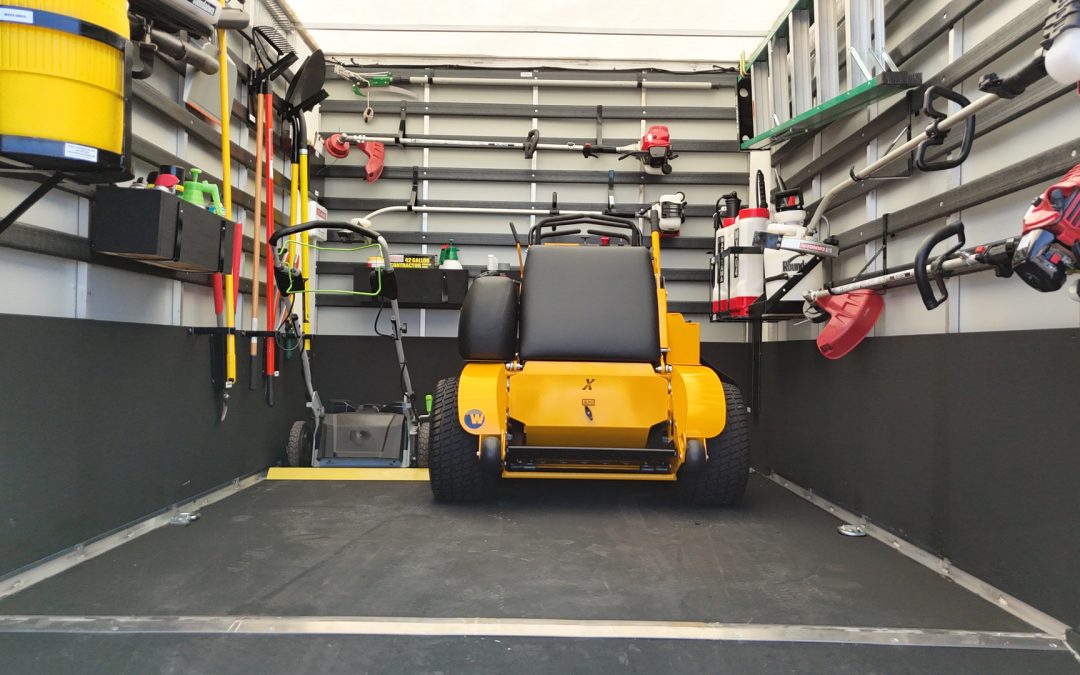
This week we traveled to Orlando, Florida, for The Landscape Show and displayed three different models of Super Lawn Trucks. We demonstrated how trucks can be configured differently for lawn maintenance crews versus landscape crews.
Our displays included a well-organized tool display with 3 dozen landscape tools neatly organized along with detailed tool-identification nameplates showing exactly where tools belonged.
Several contractors looked inside and said:
“My guys would destroy this truck in a week.”
That always makes me smile. 🙂
We’ve been building these trucks since 1998. They’re designed for commercial landscape crews and thousands of loading cycles.
So, when I hear comments like this, I know the problem isn’t the truck.
Maybe it’s their current system—or the lack of one in those companies who think of their employees as destructive or unable to follow a simple system.
Successful companies don’t simply hope employees will respect their tools and equipment. They train them.
That’s exactly what Larry did with Johnny.
Within a short time, Johnny knows the names of the tools. He knows where to find them. He knows where to return them. He spends less time searching and more time producing.
Johnny becomes more productive.
And something else happens.
Johnny likes working for Larry.
There’s less confusion. Less frustration. Johnny has what he needs to succeed.
Customers notice, too.
The crew arrives prepared. The work looks professional. Difficult jobs appear easy. Larry can command a premium because customers aren’t buying hours—they’re buying results.
And when Johnny enjoys his job, understands what’s expected and has the tools necessary to succeed, he’s more likely to stick around.
That’s the bigger lesson.
Organization isn’t about making a pretty truck. It’s about creating a repeatable business system.
Build enough little systems like this and productivity starts multiplying throughout your company, crew after crew.
Your competitors can hire people.
They can buy trucks.
They can buy tools.
But when you build better systems for ordinary people to produce extraordinary results, you’ve built something much harder to copy.
And that’s how a simple place to store a pair of lopping shears, properly labeled, with names in English, Spanish and an image can help build a better landscaping company.
If you need help, we're here.
Just hit reply and tell us what's on your mind.
Produce Greatly,
Tony Bass, founder
P.S. Want to know how productive your landscape company really is?
Take the Wealthy Landscaper Productivity Challenge and compare your company’s financial productivity against some of the most productive lawn and landscape companies in the USA.
The video, the handout and full instructions are available right here.
You might be surprised at what the numbers reveal—and where a few simple improvements could put a whole lot more money on your bottom line.